




Highlights of this issue: the 27th International Argo Data Management Team meeting convened in Brest, France, as deep-sea and biogeochemical observation networks expand rapidly while funding concerns emerge; US underwater gliders carried out the first direct observations beneath a super typhoon in the Northwest Pacific; China's Jiaolong manned submersible completed 7,000-meter-class sea trials and set out for the South Pacific; China's Guanlan experimental satellite — the world's smallest and lightest altimetry satellite — reached orbit; KONGSBERG released two new sonars and is advancing its "AI virtual sonar operator"; and China's NDRC set a target of RMB 13 trillion in gross ocean product by 2030.
I. Global Observation Networks: Deep-Sea Argo Accelerates, Funding Gap Emerges as the Biggest Variable
From October 12 to 16, the 27th Annual Meeting of the International Argo Data Management Team (ADMT-27) was held in Brest, France, with nearly 70 in-person delegates. The meeting reported that, as deep-Argo missions shift from regional to global deployment and EasyOneArgo together with cloud-based data products approach release, the scale of Argo data use will continue to grow while barriers to access keep falling; the polar missions team has finalized the delayed-mode quality-control procedures and position-computation methods for under-ice floats in the 0–2000 decibar range, clearing a key technical hurdle for polar observation. The meeting also warned, however, that no country has so far committed long-term funding for OneArgo, and the US GO-BGC program — which accounts for roughly ninety percent of all BGC floats — will end in late 2026, leaving the existing biogeochemical array under severe pressure to sustain itself. (Source: China Argo Real-time Data Center)
On the science side, a November study in Geophysical Research Letters (GRL) by a team from the Second Institute of Oceanography, Ministry of Natural Resources, used high-frequency temperature-salinity, dissolved-oxygen, chlorophyll and particle backscattering profiles from a BGC-Argo float (WMO 2902911) deployed in the Northwest Pacific to capture, for the first time, a persistent deep-water particle layer inside a decaying cyclonic eddy, proposing a new pathway by which fine particles are exported to depth along isopycnals — fresh observational evidence for the study of the ocean's biological carbon pump. (Source: State Key Laboratory of Satellite Ocean Environment Monitoring and Early Warning)
II. Mobile Platforms: Gliders Dive into a Typhoon's Core, Formation Technology Takes Shape
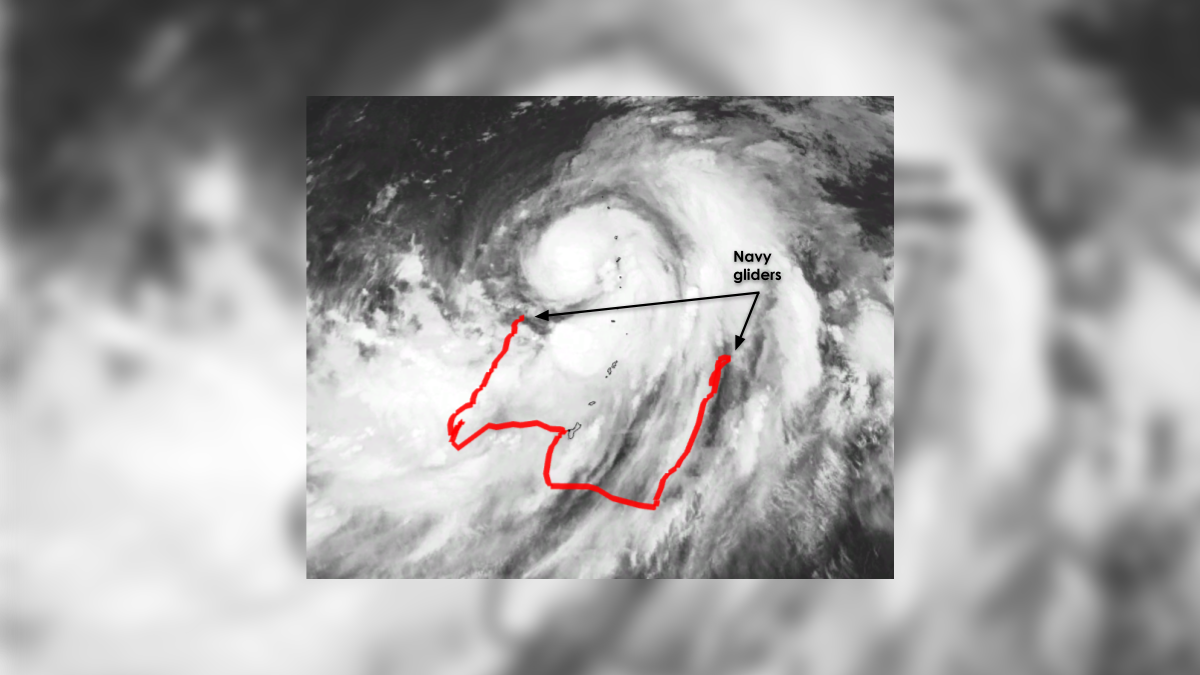
The November briefing of the US Integrated Ocean Observing System (IOOS) disclosed a "historic first": in early October, two US Navy underwater gliders collected subsurface data before, during and after the passage of Super Typhoon Choi-wan in the Northwest Pacific — the first time NOAA has obtained glider profiles directly beneath a major storm in that region. During the same period, other gliders identified a pool of warm water beneath the forecast track of Hurricane Trudy, helping improve intensity forecasts. The long-standing observation gap in air–sea energy exchange inside typhoons is being filled by this low-cost "glider + hurricane" combination. (Source: US IOOS, Eyes on the Ocean, November 2026 issue)
Domestically, a team from Tianjin University of Technology published a November review of underwater glider formation technology, grouping formation applications into two main lines — ocean phenomena observation and target detection — and systematically assessing key technologies such as coordinated control, task allocation, path planning and formation communications. The evolution from single-vehicle observation to multi-vehicle cooperative networking has become the shared technical route of China, the US, Europe and Australia. (Source: ScienceNet.cn)
III. Manned Deep Diving and the Hadal Zone: Jiaolong Steps Up a Gear, Hadal Program Goes Global
On October 27, the twice-upgraded Jiaolong manned submersible completed 7,000-meter-class sea trials in the Philippine Basin, with two of three dives exceeding 7,000 meters and a maximum depth of 7,056.9 m. This upgrade fitted high-energy-density oil-immersed lithium battery packs and domestically developed direct-drive low-noise DC thrusters, and applied deep-sea hydraulic buoyancy adjustment and ultra-high-definition imaging systems, enabling "two dives a day". By early November Jiaolong had logged 475 dives in total, and is now on the second leg of China Ocean voyage 100 aboard the Shenhai Yihao support vessel on its first mission to the South Pacific. (Source: Xinhua)
On November 4, the international regional sub-centers of the Global Hadal Exploration Program were unveiled in Sanya, including the Americas sub-center in Chile, the European sub-center in Denmark and the Oceania sub-center in New Zealand. Initiated by the Institute of Deep-sea Science and Engineering of the Chinese Academy of Sciences, the program has been selected into the UN "Ocean Decade" action plan and has so far joined scientists from 13 countries in deep-diving surveys of 12 of the world's hadal trenches. (Source: Hainan Provincial People's Government website)
IV. Digital Basemaps and Space-Based Observation: Seamount Atlas Released, World's Lightest Altimetry Satellite Launched
On November 5, at the opening ceremony of Xiamen International Ocean Week, the China Ocean Affairs Administration of the Ministry of Natural Resources and the National Marine Data and Information Center released the Seamount Atlas — China's first digitalized spatial geographic-information product for seamounts. Integrating multibeam bathymetry, sediment sampling, underwater video and other multi-source data, it covers 54 seamounts named by China and entered in the international undersea gazetteer, and generates four categories of thematic products — terrain, geomorphology, substrate and physical habitat — for four representative seamounts in the Western Pacific, serving implementation of the BBNJ Agreement and the designation of high-seas protected areas. (Source: China News Service)
At 7:37 a.m. on November 7, a Ceres-2 rocket successfully launched four satellites from Jiuquan, among them the Guanlan experimental satellite, developed under the lead of Laoshan Laboratory — the world's first small satellite to carry a Ka/Ku dual-frequency synthetic-aperture radar altimeter, and the smallest and lightest altimetry satellite in the world. Adopting a dual-frequency shared-aperture antenna and a low-orbit design, it will conduct round-the-clock, all-weather routine observation of global sea surface height after entering orbit, providing pilot validation for future constellations of altimetry satellites. (Source: Xinhua; Shanghai Academy of Spaceflight Technology)
V. Instrument Industry: Sonar Family Rounds Out to Three Models, AI Operators and Domestic ROVs Compete on the Same Stage
According to maritime-technology media on November 3, Norway's KONGSBERG released the Aegir17 and Aegir57N underwater surveillance sonars, which together with the Aegir57 launched in August form a three-model "subsea situational awareness" (SSA) product family, all open for ordering: Aegir17 uses a lower acoustic frequency and a larger transducer to provide large platforms with long-range 360-degree detection; Aegir57N is a compact array sonar supporting forward-looking navigation and obstacle detection in poorly charted waters, and can be integrated into unmanned surface vessels and fixed installations. At the same time, KONGSBERG announced a deepened partnership with US automation-platform company Viam to develop an "AI virtual sonar operator" that automatically detects and tracks underwater targets; first commercial deliveries of the Aegir sonars are planned to complete this month. (Source: Marine Technology News, Naval News)
On the domestic front, at the "Light of the Internet" Expo in Wuzhen from November 2 to 5, the fully in-house developed multifunctional AI underwater robot "Xingyao" was officially released: maximum diving depth of 100 meters, a six-thruster vectored layout, 4K imaging, a domestic SoC main controller and an AI edge-inference unit, targeting aquaculture, hull inspection, wind-power operations and maintenance, and underwater rescue. Underwater perception is pushing forward on both the "intelligent" and "autonomous" fronts at once — algorithms moving down into devices while AI moves up into the operator's seat. (Source: Sina Finance)
VI. Ocean Economy and AI: The RMB 13 Trillion Target Takes Shape, Computing Power "Goes to Sea"
On November 3, at the first press conference of the NDRC's "Forging Ahead with the 15th Five-Year Plan" series, it was made clear that China's gross ocean product reached RMB 8.5 trillion in the first three quarters of 2026, up 4.9 percent year on year and 0.3 percentage points above GDP growth, and that by 2030 the gross ocean product will exceed RMB 13 trillion, with an explicit call to "expand the application of artificial intelligence in the marine domain". Industry-side moves have been intensive: China's first "Ocean Token Factory" recently landed in Qingdao, supplying marine data, computing power and model services on demand to small and medium marine enterprises on a token-metering basis; fisheries-domain large models and shipbuilding-and-marine-engineering industry large models have already been deployed at leading enterprises. (Source: NDRC press conference; Zhonghong Net)
VII. Marine Life Science: A Cold-Seep "Dragon Pearl" Rewrites the Understanding of Chemosymbiosis
In early November, a team led by Pei-Yuan Qian at the Guangzhou Marine Laboratory, together with Ocean University of China and Hong Kong Baptist University, published findings in Nature Communications: within an aplacophoran mollusk living at the "Haima" cold seep in the South China Sea, the researchers identified the first specialized multilayer-membrane organelle dedicated to housing and cultivating sulfur-oxidizing symbiotic bacteria — named the "dracosphera" ("dragon pearl"), wrapped in more than 20 dense lipid membranes that block oxygen from reaching the symbionts while prioritizing trace oxygen for the host, revealing how deep-sea life adapts to extremely hypoxic environments. The species was previously selected as one of the "Top 10 Marine New Species of 2024". (Source: ScienceNet.cn; Guangzhou Marine Laboratory)
Editor's Observation
Looking across this issue's developments, three clear threads run through the global ocean-observation system: first, the focus of observation is extending from the upper ocean toward the deep sea and biogeochemistry — OneArgo's global deployment keeps advancing, while the existing biogeochemical float array faces sustainment pressure as program cycles end, making international funding arrangements a shared concern; second, platform intelligence has entered the product-delivery stage — AI sonar operators begin commercial delivery this month and several domestic AI underwater robots have been released, with industry competition extending from sensor accuracy toward integrated "perception + cognition" capability; third, the path toward miniaturized, constellation-based spaceborne ocean observation is increasingly clear, with the payload architecture and network-validation results of new altimetry satellites drawing wide industry attention. Deep-water sensor components, low-power observation platforms and AI data processing are becoming the directions in which resources and R&D investment in global marine science and technology are concentrating fastest.
Source statement: This article is compiled from public reporting and institutional releases by Xinhua, China News Service, ScienceNet.cn, the China Argo Real-time Data Center, the State Key Laboratory of Satellite Ocean Environment Monitoring and Early Warning, the US IOOS, NOAA, Marine Technology News, Naval News, the National Development and Reform Commission and others; opinion sections represent editorial observation and are for reference only. Figures 1 and 2 are works of the US government (public domain), with original credits noted. For announcements and papers, please refer to the original publications.