




Highlights of this issue: sea temperatures in the central and eastern equatorial Pacific keep breaking records, with multiple national agencies confirming the strongest El Niño since observations began and a vast heat reservoir stored beneath the surface; an international team using Argo float data has found that Antarctic Intermediate Water changed character abruptly after 2016; at Euronaval in Paris, the US and France unveiled extra-large unmanned undersea vehicle (XLUUV) designs in succession, with "mother-ship" undersea platforms the common route; a flexible temperature-depth sensor developed by the Institute of Deep-sea Science and Engineering, CAS, completed deep-sea validation at 4,812 meters aboard the Fendouzhe (Striver); and Shanghai released its marine-economy 15th Five-Year implementation plan, pioneering the confirmation of marine data rights and marine data trading.
I. Climate and Observation: El Niño Breaks Records While the Subsurface Heat Reservoir Keeps Building
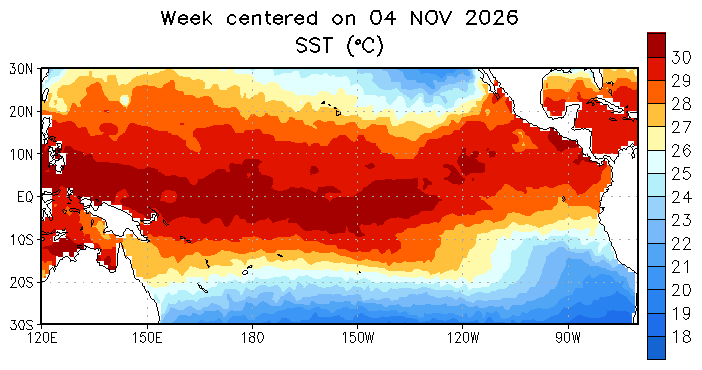
This week, meteorological agencies around the world confirmed in succession that the developing El Niño event has broken historical records. The Japan Meteorological Agency reported that equatorial eastern Pacific sea temperatures in October were 4.4 °C above the long-term average, exceeding the 4.0 °C record set only last month — the strongest El Niño since records began in 1949. An update from Australia's Bureau of Meteorology on November 10 showed a weekly Niño3.4 sea-temperature index of +2.75 °C for the week ending November 8, after a peak that briefly reached +2.88 °C; every international model it reviewed expects the event to peak in November–December and persist into 2027. In NOAA's daily sea-temperature dataset, the Niño3.4 sea surface temperature stood at about 29.91 °C on November 7 — 3.13 °C above the 1991–2020 average and beyond the same-period record of the strong 2015 El Niño; mid-Pacific sea temperatures have set same-period highs for 162 consecutive days in the satellite record. (Sources: Japan Meteorological Agency, Australian Bureau of Meteorology, NOAA (OISST), Columbia University IRI, National Climate Center (compiled from public reporting))
More noteworthy still is what lies beneath the surface: the latest assessment from Columbia University's International Research Institute for Climate and Society (IRI) shows that subsurface water temperatures at 50–150 meters depth in the central and eastern equatorial Pacific are more than 8 °C above the long-term average across a broad expanse of ocean, with NOAA observations exceeding 10 °C at some depths. This not-yet-released subsurface heat reservoir is regarded as the important energy source supporting the continued development of the event. The National Climate Center predicts that equatorial eastern Pacific sea temperatures will peak around November–December, potentially forming the strongest El Niño event since observations began. The persistent temperature anomaly is also reflected in typhoon activity: on November 7, Typhoon Cempaka — the 32nd of the year — formed, bringing the 2026 typhoon count to 32 and setting an annual record for the 21st century.
II. Marine Science: Argo Data Reveal an Abrupt Reversal of Antarctic Intermediate Water
A study reported on November 12 in Nature Climate Change shows that the character of a key Southern Hemisphere water mass is changing abruptly. An international team from the University of Melbourne, the Indian Institute of Science and the University of Southampton analyzed the global Argo float array (about 4,000 autonomous profiling floats) together with satellite and atmospheric data and found that from 1995 to 2015, melting Antarctic summer sea ice kept supplying freshwater to Antarctic Intermediate Water (AAIW), whereas from 2016 to 2024, as Antarctic sea ice shrank to historic lows, meltwater input declined markedly and the water mass became saltier, denser and deeper within just a few years — an abrupt reversal of the long-term trends in salinity and density, and the first direct observational evidence of changing AAIW properties. The team notes that this shift could affect the global meridional overturning circulation and Southern Hemisphere weather and climate over the coming years to decades, and could allow more heat to enter the deep ocean, suggesting that existing models may underestimate deep-ocean warming. Global autonomous observing arrays such as Argo are becoming a key means of capturing such abrupt changes. (Source: Nature Climate Change (University of Melbourne release))
III. Unmanned Platforms: A Wave of Unveilings at Euronaval as the XLUUV Race Heats Up
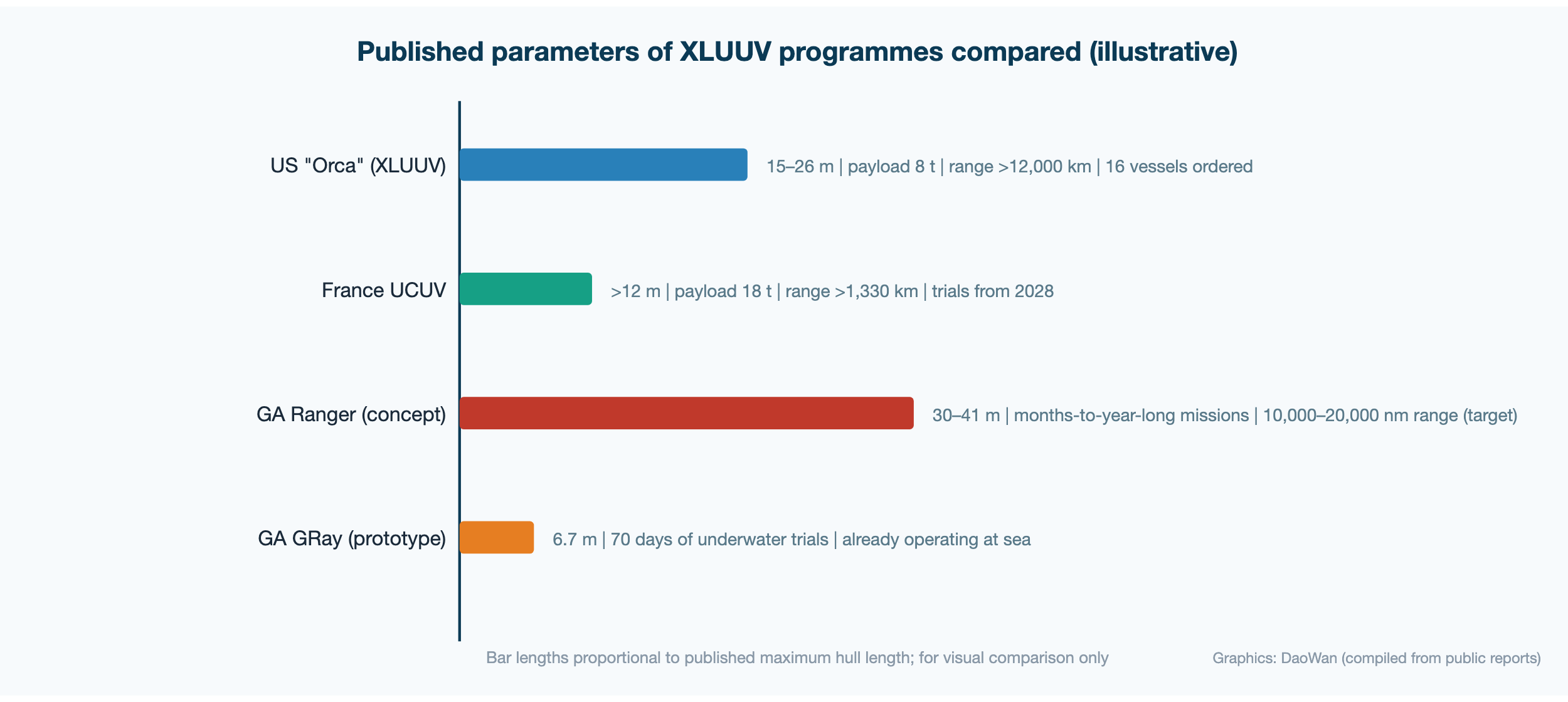
At Euronaval 2026, held in Paris from November 3 to 6, extra-large unmanned undersea vehicles (XLUUVs) were the most concentrated theme of new announcements. General Atomics (GA-EMS) unveiled two blended-wing-body underwater gliders, the Ranger and the GA-Ray (GRay): the GRay is 6.7 meters long and already operating at sea, with underwater trials lasting up to 70 days; the Ranger is a 30–41 meter-class concept platform intended to carry out multi-year continuous underwater missions with a range of tens of thousands of nautical miles, able to carry 16 to 96 small unmanned undersea vehicles, or transport standard-container-sized payload modules and settle on the seabed to await tasking. Both platforms replace propeller-driven propulsion with buoyancy-driven gliding in exchange for extremely low underwater energy consumption; the company says the aim is precisely the "endurance and reach" weakness that conventional submersibles find hardest to overcome. (Sources: Naval News, Army Recognition, Baird Maritime)
On the French side, Reference News reported on November 12, citing the French daily Les Échos, that Naval Group's extra-large "unmanned combat undersea vehicle" (UCUV), developed in-house over nearly a decade, has formally surfaced: the vehicle is over 12 meters long with a range exceeding 1,330 kilometers and can carry up to 18 tons of sensors, torpedoes and mines; the French Navy has ordered a demonstrator, with trials and small-batch procurement targeted from 2028. The report also mapped out the overall state of this race: Boeing's US "Orca" XLUUV is 15–26 meters long with an 8-ton payload and a range of more than 12,000 kilometers, has completed its first long-range mission and holds orders for 16 vehicles; Anduril's Dive-XL has also been selected for the US Navy's new-generation extra-long-range concept. Unmanned undersea platforms are moving from "single-vehicle reconnaissance" toward "mother-ship delivery + distributed operations", with low-energy propulsion, long-endurance energy systems and autonomous decision-making the focus of competing development efforts. (Source: Reference News (citing Les Échos, France))
IV. Deep-Sea Instruments: Flexible Temperature-Depth Sensor Validated at 4,812 m aboard Fendouzhe
On November 7, Nature Communications published results from a team at the Institute of Deep-sea Science and Engineering, Chinese Academy of Sciences: a bendable flexible temperature-depth sensor was carried by the manned submersible Fendouzhe to a depth of 4,812.2 meters, completing deep-sea validation at roughly 50 megapascals of water pressure. The sensing element is a porous composite of laser-direct-written graphene and silicone rubber, and the electronics draw a resting average current of just 24.63 microamps; combined with a machine-learning compensation algorithm built on a small neural network and polynomial fitting, the measured depth error is no more than ±0.91 percent of full scale and temperature accuracy ±0.29 °C. Unlike rigid instruments that can only take "point measurements", flexible devices can be attached to curved, moving, unconventional carrier surfaces, offering a new component-level route toward full-field observation of ocean dynamic processes — "flexible materials + AI compensation" is moving from the laboratory into the real deep sea. (Source: Nature Communications (open-access paper))
V. Ocean Economy and Policy: Shanghai Pioneers Marine Data Rights Confirmation and Trading
On November 10, the Shanghai Municipal Ocean Bureau issued the "Shanghai Implementation Plan for Marine Economic Development during the 15th Five-Year Plan Period", setting targets that by 2030 the added value of marine industries will be no less than RMB 350 billion and the number of high-tech enterprises in the marine field no fewer than 1,200, and explicitly calling for the R&D and application of key equipment such as ocean sensors, marine intelligent robots and submersibles. On the data-element front, the plan proposes studying the construction of a marine data trading platform, piloting first-mover trials in the confirmation of marine data rights, valuation, trading, revenue and governance, encouraging the development of marine-domain vertical large models, and supporting the Lingang undersea data center in exploring a fusion model of "offshore wind power + undersea computing power". The concurrently released "China Marine Economy Report 2026" shows that China's gross ocean product exceeded RMB 11 trillion in 2025, accounting for 7.9 percent of GDP; per Securities Daily, marine plans for the 15th Five-Year period have recently been issued intensively by Jiangsu, Fujian, Liaoning and other provinces, with the deep sea and data elements the common keywords. (Sources: Shanghai Municipal Ocean Bureau (per STCN.com), Securities Daily Network)
Editor's Observation
Looking across this issue's developments: on the climate side, an El Niño event that may rewrite the record books stands on the eve of its peak, its evolution tracked continuously by surface observation together with Argo, satellites and other multidimensional means — the quantified assessment of the subsurface heat reservoir underlines the foundational role of underwater profile observation in climate services; on the science side, research into abrupt water-mass changes based on global autonomous arrays has entered public view, and the value of long, continuous temperature-salinity records is becoming ever more apparent; on the platform side, extra-large unmanned undersea vehicles in the US and Europe have simultaneously entered prototype validation and small-batch ordering stages, with buoyancy gliding and other low-energy propulsion routes and "mother ship — vehicle" architectures the common choice in public designs; on the component side, the combination of flexible sensing and machine-learning compensation has completed real-world deep-sea validation, and the evolution of sensor form factors and data processing is becoming more plural; on the industry side, platforms for confirming, valuing and trading marine data have begun to enter local implementation plans, and institutional exploration of marine data as a production factor has started. All of these threads point to the same backdrop: the accuracy, density and datafication of ocean observation are being given a higher priority than ever.
Source statement: This article is compiled from public reporting and institutional releases by the Japan Meteorological Agency, the Australian Bureau of Meteorology, NOAA, Columbia University IRI, the National Climate Center, Nature Climate Change, Nature Communications, Naval News, Army Recognition, Baird Maritime, Reference News, the Shanghai Municipal Ocean Bureau, STCN.com and Securities Daily Network, among others; opinion sections represent editorial observation and are for reference only. Figure 1 is a work of the US government (public domain) with the original credit noted; Figure 2 is an infographic produced by this column. For announcements and papers, please refer to the original publications.