




Highlights of this issue: the European Centre for Medium-Range Weather Forecasts (ECMWF) has published, in the WMO Bulletin, a study that quantifies the contribution of ocean observations — satellite sea-surface temperature, Argo floats and altimetry — to 10-day forecasts one observation type at a time; the Fourth International Hadal Conference met in Wellington, New Zealand, as Fendouzhe-based findings on hadal hard-substrate faunas recently appeared in Science; the UK Royal Navy launched the £90 million "Atlantic Net" autonomous surveillance network; the sixth RobotX air–surface–underwater robot challenge was held in Singapore; a Chinese hydrographic-survey unmanned surface vehicle received Approval in Principle from Bureau Veritas; Nature published a mechanism study of virus–bacteria cooperative killing of algal blooms; and Chinese underwater robots are accelerating their overseas expansion.
I. Observation and Forecasting: The Value of Ocean Observations Weighed, One Type at a Time
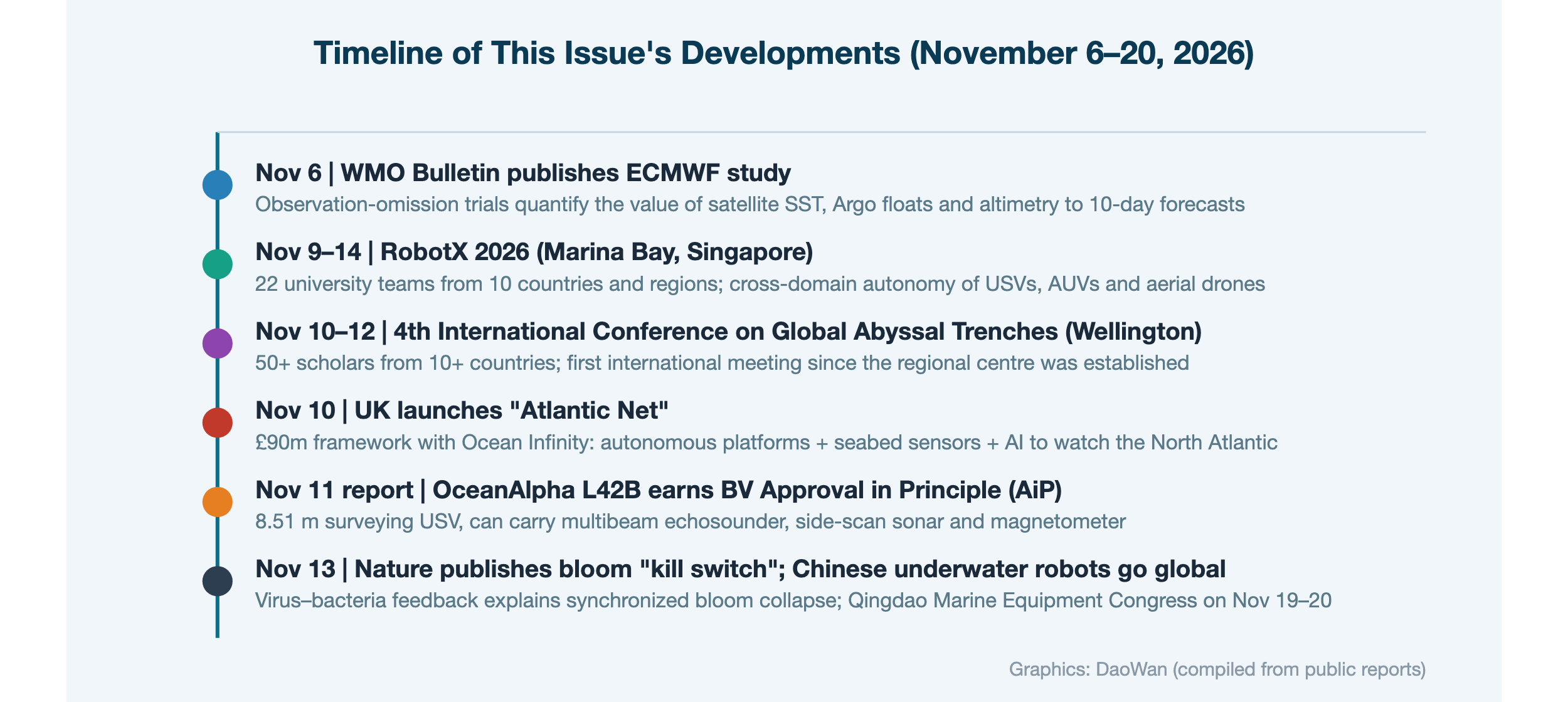
The WMO Bulletin (Vol. 75, No. 2), published on November 6, carries a study by an ECMWF team that ran "observation-denial" experiments on a full year of daily 10-day forecasts with its coupled ocean–atmosphere forecasting system — removing one class of ocean observation at a time from the assimilation system and testing the change in forecast skill. The results show that satellite sea-surface temperature has the biggest impact: without it, both ocean and atmospheric forecast accuracy degrade across the entire 10-day range. Argo floats improve estimates both at the surface and below it, and the forecast loss caused by removing Argo is roughly equivalent to erasing the improvement brought by one upgrade of ECMWF's forecasting system. Satellite altimetry has a smaller but still significant effect. The study notes that observing systems complement one another and should be assessed as a whole, and that sustained investment in ocean observing pays off well beyond ocean science. ECMWF is planning to extend the same assessment to new data sources such as fishing vessels, underwater gliders and animal-borne sensors. (Sources: WMO Bulletin (ECMWF study), EuroGOOS)
II. Hadal Science: Wellington Conference Advances the Collaboration Network as Fendouzhe-Based Findings Reach Science
From November 10 to 12, the Fourth International Hadal Conference was held in Wellington, New Zealand, co-hosted by the Institute of Deep-sea Science and Engineering (IDSSE) of the Chinese Academy of Sciences together with Geoscience Society of New Zealand, Te Papa and Victoria University of Wellington, bringing together more than 50 scholars from over ten countries including Denmark, Germany, the United Kingdom, Chile, the Netherlands, Australia and the Cook Islands. The conference discussed four themes — biodiversity and evolution, carbon cycling and biogeochemistry, tectonic and geological processes, and chemosynthetic ecosystems. It was the first international conference since the three continental regional sub-centers of the Global Hadal Exploration Programme were established in 2026, marking the network's shift from headquarters-led coordination to regionally coordinated, routine operation. (Source: Chinese Academy of Sciences Guangzhou Branch)
In the same period, the journal Science published a study of hadal hard-substrate faunas carried out using the manned submersible Fendouzhe: the team performed large-scale imaging and sampling on rock hard substrates at 9,000-10,898 meters in the Kermadec and Mariana trenches, recording sessile communities of 32 species across six protist and metazoan phyla, most of them millimeter-sized and new to science. The study shows that the dominant filamentous organisms are heterotrophic foraminiferans, revising the earlier chemolithoautotrophy-led hypothesis, and suggests that similar sessile communities are widespread across seven hadal regions around Oceania, forming previously unrecognized carbon hotspots in hadal trenches. (Source: Science)
III. Unmanned Platforms: From Single-Vehicle Autonomy to Cross-Domain Networking
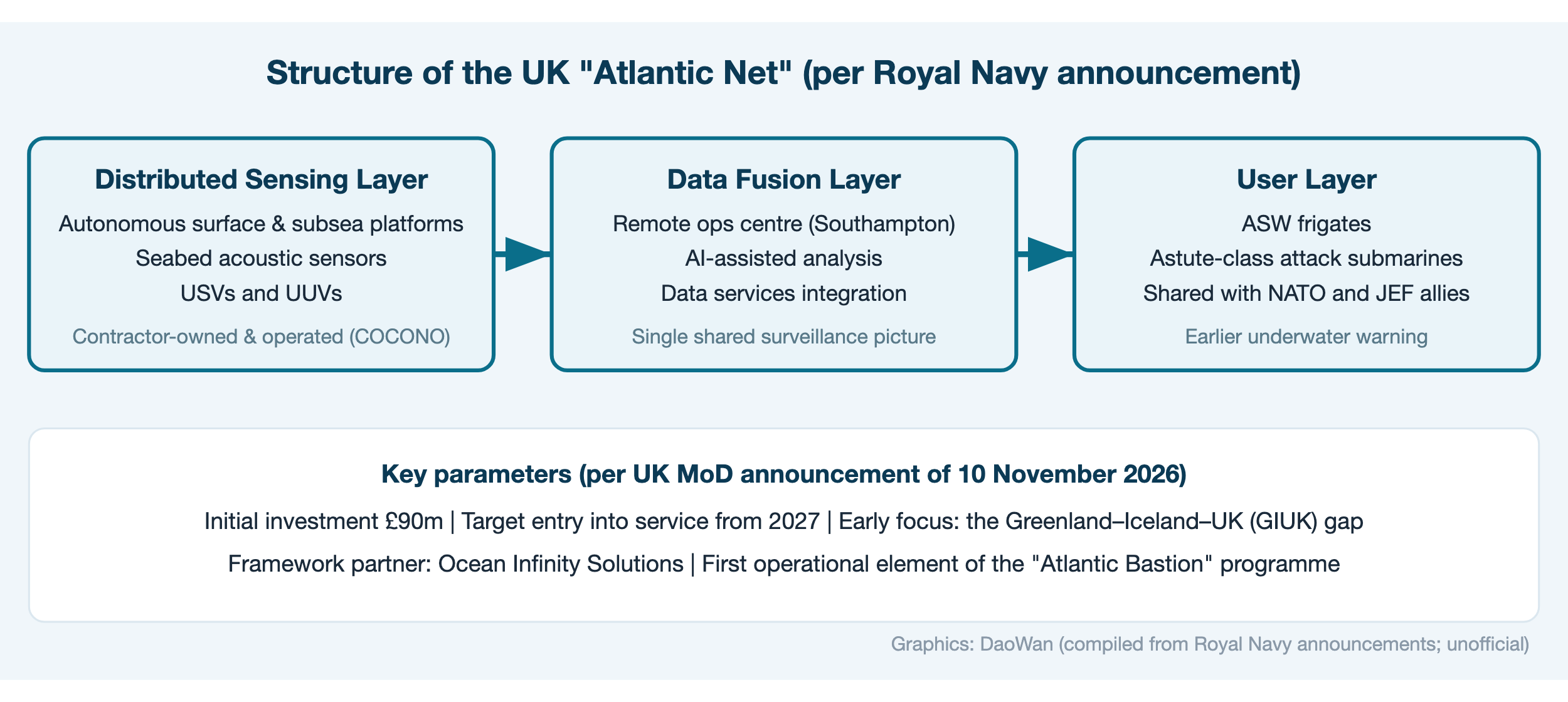
On November 10, at the International Sea Power Conference in Oslo, Norway, the UK Ministry of Defence announced a framework agreement with maritime robotics company Ocean Infinity Solutions to launch "Atlantic Net": a persistent surveillance network over the North Atlantic built from autonomous surface and undersea platforms, seabed sensors and artificial-intelligence data analysis, with the Greenland-Iceland-UK (GIUK) gap as an early focus, an initial investment of £90 million and a target of becoming operational from 2027. The network follows a contractor-owned, contractor-operated (COCONO) model and is the first operational element of the Royal Navy's wider "Atlantic Bastion" programme, intended to give anti-submarine warships and Astute-class attack submarines earlier warning of activity beneath the surface. (Sources: Royal Navy, Navy Lookout, Army Recognition)
From November 9 to 14, the sixth Maritime RobotX Challenge returned to Singapore's Marina Bay after 12 years, co-hosted by Singapore's Ministry of Defence and the US Office of Naval Research and drawing 22 university teams from 10 countries and regions. Under the theme "Storm Response", teams had to complete cross-domain autonomous coordination tasks with unmanned surface vehicles, unmanned underwater vehicles and aerial drones without human remote control, with aerial-drone collaboration introduced for the first time; the first Trident-X maritime unmanned robot challenge for Singapore institutions was held alongside, with more than 85 student teams from 28 institutions taking part. (Source: Lianhe Zaobao)
International standardization recognition for Chinese equipment is also advancing: Bureau Veritas (BV) has recently issued an Approval in Principle (AiP) certificate for the OceanAlpha L42B hydrographic-survey unmanned surface vehicle. The L42B is an 8.51-meter aluminum catamaran USV designed for marine hydrographic and geophysical surveying; its modular payload platform can carry a multibeam echosounder, side-scan sonar and magnetometer, and in calm water it can operate continuously for up to 8 days at 4 knots with a range of 1,500 kilometers. The approval was assessed against BV's Autonomous Ship Guidelines (NI 641), covering general arrangement, communication and control architecture and operational scenarios. (Source: International Shipwright/eworldship)
IV. Marine Life Science: Virus-Bacteria "Cooperative Killing" Explains Synchronized Algal Bloom Collapse
On November 13, Nature published a study explaining a phenomenon that has long puzzled oceanographers: when an algal bloom collapses collectively, fewer than 30 percent of the algal cells are actually infected by viruses — so what kills the rest? Experiments showed that after viruses infect Gephyrocapsa huxleyi, the organic matter released changes the metabolic profile and attracts Alteromonadaceae bacteria to colonize algal aggregates and accelerate the death of the remaining cells, forming a positive feedback of "viruses opening the way, bacteria finishing the job" — in the control group containing a natural bacterial community, algal density fell to about 10² cells per milliliter by day 6 of viral infection, while suppressing bacteria with antibiotics kept it at about 10⁴. Field data support the same mechanism: in a bloom patch tracked over five days of collapse in the Celtic Sea in 2019, the relative abundance of Alteromonadaceae rose more than 100-fold. The researchers point out that cooperative killing channels more carbon into surface recycling rather than export to the deep ocean, affecting the course of the ocean carbon cycle. (Source: Nature (via Ecology Restoration Network commentary))
V. Industry and Regions: Underwater Robots Go Global as Qingdao Prepares to Host the Marine Equipment Innovation Conference
According to a People's Daily Overseas Edition report on November 13, China's underwater robot industry is accelerating its global expansion: Shandong Future Robotics has launched more than 50 deep-sea operation robots capable of high-precision tasks such as seabed pipeline laying, inspection, grabbing and cutting, with products exported to more than 30 countries and regions; products of Shenzhen Qianxing Innovation Technology have entered more than 130 countries and regions, with overseas business accounting for more than 85 percent over the long term. In addition, per Guanhai News, the Fourth Marine Equipment Science and Technology Innovation Conference will be held in Qingdao on November 19-20, hosted by the China Ocean Engineering Consulting Association under the theme "Innovation-driven, Collaborative Integration: Pushing Deep-sea Engineering Equipment to New Breakthroughs", releasing a marine equipment yearbook and running sub-forums on deep-sea intelligent equipment innovation, international cooperation and going global, and marine robot application matching. (Sources: People's Daily Overseas Edition, Guanhai News)
Editor's Observation
Looking across this issue's developments: on the assessment side, the value of ocean observation is entering a stage of quantitative accounting, with the contributions of satellite SST, profiling floats and altimetry being distinguished one by one, and methods for evaluating observing systems as a whole taking shape; on the science side, the systematic discovery of hadal sessile communities advances in parallel with the routine operation of the global hadal collaboration network, and the question of hadal biology is shifting from "is there life" to "how are the communities organized and functioning"; on the platform side, unmanned systems show two lines of evolution — networking and cross-domain operation — with military distributed surveillance networks rapidly meshing under contractor-operated models while civilian cross-domain robot competitions and classification-society approval schemes develop in step, as the traditional shipping world's standardized assessment begins to reach autonomous ships; on the ecology side, research on the microbial mechanisms of bloom collapse links viruses, bacteria and carbon export pathways; on the industry side, the overseas market coverage of underwater robot companies keeps expanding. Observation assessment, hadal exploration, autonomous networking and industrial going-global together point to a continuing deepening of the datafication and systematization of ocean activities.
Source statement: This article is compiled from public reporting and institutional releases by the WMO Bulletin, EuroGOOS, the Chinese Academy of Sciences Guangzhou Branch, Science, Nature, the Royal Navy, Navy Lookout, Army Recognition, Lianhe Zaobao, eworldship, People's Daily Overseas Edition and Guanhai News, among others; opinion sections represent editorial observation and are for reference only. Figures 1 and 2 are infographics produced by this column. For announcements and papers, please refer to the original publications.